The Hidden Operational Challenges Behind the AI Boom
Most people experience artificial intelligence through a screen.
A chatbot generating responses in seconds. A recommendation engine predicting behavior. An AI assistant automating workflows. A generative model producing images, code, or research almost instantly.
But the real story of AI is not happening on the surface.
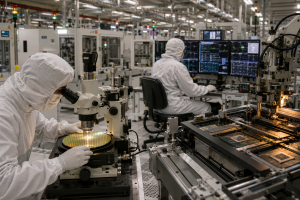
It is happening deep inside semiconductor fabs, advanced packaging facilities, inspection systems, manufacturing lines, and compute infrastructure operating under unprecedented pressure.
Behind every large AI model sits an enormous industrial ecosystem responsible for producing the physical infrastructure that makes modern AI possible. Semiconductor manufacturing, GPU production, wafer inspection, memory packaging, thermal engineering, and intelligent quality systems have quietly become some of the most strategically important foundations of the global economy.
As AI adoption accelerates worldwide, the conversation is beginning to shift.
The next challenge may no longer be whether AI models can become more powerful. The challenge is whether the underlying industrial systems supporting AI can scale with sufficient precision, reliability, efficiency, and operational resilience.
And increasingly, some of the most important AI problems are no longer purely software problems.
They are manufacturing problems.
The Semiconductor Industry Is Entering a New Era of Pressure
The rapid growth of AI infrastructure is placing enormous pressure on semiconductor manufacturing ecosystems across the world.
Modern semiconductor fabs are expected to produce increasingly advanced chips at:
- higher speed
- higher volume
- lower defect tolerance
- greater energy efficiency
- and significantly tighter manufacturing precision
At the same time, semiconductor architectures continue becoming more complex.
Shrinking transistor nodes, heterogeneous integration, chiplet-based architectures, advanced packaging methods, and high-bandwidth memory systems are dramatically increasing manufacturing sensitivity across production environments.
This complexity creates a difficult operational reality.
Even microscopic manufacturing inconsistencies can impact:
- chip reliability
- thermal behavior
- signal integrity
- power consumption
- packaging stability
- and overall manufacturing yield
For semiconductor manufacturers, the challenge is no longer simply producing chips.
It is maintaining manufacturing precision consistently at scale while demand continues accelerating globally.
This becomes particularly important in AI infrastructure environments where advanced GPUs and high-performance compute systems depend on extremely tight manufacturing tolerances and packaging reliability.
As AI systems become larger and more compute-intensive, the semiconductor ecosystem supporting them is being pushed toward operational limits that many facilities were never originally designed to handle.
AI Infrastructure Is Creating Invisible Manufacturing Complexity
From the outside, AI appears almost entirely digital.
But underneath, the AI boom is creating immense physical infrastructure strain.
The growth of large-scale AI systems is rapidly increasing demand for:
- GPUs
- HBM memory systems
- advanced semiconductor packaging
- high-density compute infrastructure
- thermal management systems
- wafer manufacturing capacity
- and high-speed interconnect technologies
This demand is creating cascading pressure across semiconductor supply chains and manufacturing operations.
Production facilities are now expected to maintain both scale and microscopic precision simultaneously — a combination that becomes increasingly difficult as architectures become more advanced.
Advanced packaging technologies illustrate this challenge particularly well.
Modern AI workloads require:
- higher memory bandwidth
- lower latency
- tighter component integration
- improved thermal efficiency
- and higher interconnect density
To support these requirements, manufacturers are increasingly adopting sophisticated packaging methods that are significantly more complex than traditional semiconductor assembly.
But as packaging complexity increases, so do inspection and reliability challenges.
Manufacturers now need to monitor:
- bonding integrity
- thermal behavior
- alignment precision
- structural consistency
- substrate reliability
- microscopic packaging defects
- and stress-related anomalies
At advanced scales, even small defects can potentially affect long-term reliability, performance stability, or operational lifespan.
This creates a growing need for more intelligent inspection systems capable of operating with both speed and precision across increasingly data-heavy manufacturing environments.
Why Inspection Systems Are Becoming Critical to Manufacturing Scalability
One of the less visible bottlenecks inside semiconductor manufacturing environments is inspection complexity.
Modern fabs generate enormous volumes of inspection data across:
- wafer fabrication
- lithography
- etching
- metrology
- bonding
- advanced packaging
- and final testing workflows
As production scales, inspection systems are generating growing numbers of anomalies, alerts, and defect classifications.
And that creates a major operational challenge:
false positives.
In many semiconductor environments, engineering teams spend substantial amounts of time reviewing anomalies that may not represent meaningful manufacturing defects at all.
Over time, excessive false positives can create:
- inspection bottlenecks
- slower review cycles
- operational fatigue
- inconsistent classifications
- delayed production decisions
- and increased manufacturing overhead
In high-volume production environments, even small inefficiencies in inspection workflows can scale into significant operational costs.
The issue is not simply detecting anomalies.
The challenge is identifying the right anomalies accurately, consistently, and at production scale.
This is one reason AI and computer vision technologies are becoming increasingly important inside industrial inspection systems.
Not simply to automate processes — but to improve inspection intelligence itself.
The Shift From Detection to Intelligent Inspection
Traditional inspection systems were primarily designed around rule-based detection.
But modern semiconductor manufacturing environments are becoming too complex for static inspection logic alone.
Today’s production environments involve:
- massive image datasets
- microscopic defect variation
- evolving process conditions
- highly dynamic manufacturing variables
- and increasingly sophisticated failure patterns
AI-assisted inspection systems are beginning to address these challenges by introducing more adaptive and context-aware analysis capabilities.
Computer vision systems can increasingly help manufacturers:
- improve defect classification accuracy
- reduce unnecessary manual review
- identify subtle visual anomalies
- accelerate inspection workflows
- and potentially improve manufacturing visibility across production lines
Importantly, the role of AI in these environments is not necessarily replacing engineers.
In many cases, the goal is enabling engineers to focus attention on higher-confidence and operationally relevant defects rather than spending excessive time reviewing low-value alerts.
This distinction matters.
Industrial AI becomes significantly more valuable when it improves operational decision-making rather than simply increasing automation volume.
As manufacturing complexity grows, intelligent inspection systems may increasingly become a core operational layer within semiconductor production environments.
Why False Positives Are Becoming Expensive
False positives are often discussed as a technical challenge.
But operationally, they are also an economic problem.
As inspection systems generate larger numbers of alerts, manufacturers face growing pressure on:
- engineering bandwidth
- review capacity
- production throughput
- and inspection scalability
Excessive manual review processes can potentially slow manufacturing cycles and create workflow congestion inside already high-pressure environments.
In advanced manufacturing operations, this can influence:
- cycle time efficiency
- operational responsiveness
- throughput consistency
- quality assurance scalability
- and long-term production economics
This becomes even more critical as semiconductor manufacturers attempt to scale production for AI infrastructure demand.
The industry is now operating in an environment where both precision and speed are essential simultaneously.
That combination is difficult to achieve using traditional inspection methodologies alone.
AI-assisted visual inspection systems are increasingly helping manufacturers move toward more intelligent workflows capable of prioritizing high-confidence anomalies and reducing unnecessary inspection overhead.
Over time, this may significantly reduce operational bottlenecks while improving inspection consistency across manufacturing environments.
Edge AI and Real-Time Manufacturing Intelligence
Another important shift occurring inside industrial environments is the growing adoption of edge AI systems.
Traditional manufacturing inspection architectures often rely heavily on centralized processing and post-analysis workflows.
But modern semiconductor production environments increasingly require:
- real-time responsiveness
- localized intelligence
- adaptive process monitoring
- and faster operational feedback loops
Edge AI systems are beginning to enable inspection and monitoring capabilities directly within manufacturing environments themselves.
This can potentially allow:
- faster anomaly response
- real-time defect analysis
- localized quality monitoring
- adaptive inspection workflows
- and improved operational visibility across production systems
As manufacturing throughput increases, real-time operational intelligence may become increasingly important for maintaining efficiency at scale.
The transition is no longer simply about automating manufacturing.
It is about creating manufacturing systems capable of learning, adapting, and responding dynamically to operational conditions.
The Future of Semiconductor Manufacturing May Depend on Operational Intelligence
For years, industrial transformation focused heavily on automation.
The next phase may depend more on operational intelligence.
The semiconductor industry is entering an era where manufacturing scalability increasingly depends on:
- intelligent inspection systems
- predictive quality monitoring
- adaptive manufacturing workflows
- AI-assisted operational decision-making
- and real-time production intelligence
This shift has strategic implications far beyond manufacturing efficiency alone.
The companies capable of scaling reliable semiconductor production may increasingly determine the pace of future AI infrastructure development itself.
In many ways, the AI race is also becoming a manufacturing intelligence race.
And some of the biggest competitive advantages may emerge not only from model innovation, but from operational precision inside the industrial systems supporting those models.
The Less Visible Side of the AI Economy
Consumer-facing AI applications will continue evolving rapidly.
But some of the most impactful uses of AI over the next decade may happen far away from public interfaces.
They may happen quietly inside:
- semiconductor fabs
- advanced packaging facilities
- industrial inspection systems
- electronics manufacturing environments
- and intelligent production workflows
Because ultimately, the future of AI depends not only on software capability.
It also depends on the reliability, scalability, and operational resilience of the physical systems supporting modern compute infrastructure.
As manufacturing environments continue evolving, intelligent inspection and operational AI may become some of the most strategically important — and least visible — foundations of the global AI economy.
Building the Next Generation of Intelligent Industrial Systems
At NextAstra, we see growing potential in applying AI, computer vision, and intelligent operational systems to industrial environments where manufacturing precision, scalability, reliability, and decision intelligence increasingly need to work together.
The future of industrial AI may not simply involve more automation.
It may involve more intelligent collaboration between:
- human expertise,
- manufacturing systems,
- operational data,
- and adaptive inspection technologies.
As semiconductor manufacturing complexity continues increasing, intelligent inspection systems capable of reducing false positives, improving operational visibility, and supporting scalable manufacturing precision may become increasingly important across modern industrial ecosystems.
And while much of the world focuses on the visible side of AI, some of the most important innovation may continue happening quietly behind the systems powering it.