For years, the gold standard in AI has been a relentless race for bigger and bigger models. We’ve marveled at the immense capabilities of large language models (LLMs) and foundation models—massive, general-purpose AIs trained on staggering amounts of data. While these giants are impressive, their size and computational demands make them a costly and slow solution for many real-world business applications.
So, how can enterprises leverage the power of these models without breaking the bank or sacrificing performance? The answer lies in two powerful techniques: fine-tuning and knowledge distillation.
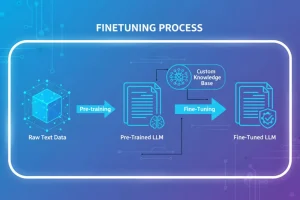
The Problem with One-Size-Fits-All AI
Imagine a highly educated generalist. They have a vast knowledge base, but if you ask them a highly specific question about, say, a niche legal doctrine or a rare medical condition, their answers might be broad or lack the necessary nuance. This is the challenge with general-purpose foundation models. They are “smart,” but not “specialized.”
To unlock their true value, they need to be taught the specific language, context, and intricacies of a particular domain. This is where fine-tuning comes in. By retraining a general model on a smaller, domain-specific dataset (like legal documents, medical records, or financial reports), we can transform a generalist into a domain expert.
From Teacher to Student: The Distillation Process
Fine-tuning alone, however, doesn’t solve the problem of size and speed. Even a fine-tuned LLM can remain a massive, resource-intensive model. This is where the magic of knowledge distillation takes center stage.
Knowledge distillation is an ingenious process where a large, highly accurate “teacher” model trains a smaller, more efficient “student” model.
Here’s how it works:
- The Teacher: A large, fine-tuned model (the teacher) has learned the complex patterns and nuances of a specific domain.
- The Training: The teacher model provides “soft labels” or probability distributions to the student model. Instead of simply saying “this is a cat,” the teacher tells the student, “I’m 95% sure this is a cat, but there’s a 3% chance it could be a lynx and a 2% chance it’s a tiger.” This rich, nuanced information is far more valuable than a simple correct/incorrect label.
- The Student: The student model learns to mimic the teacher’s reasoning and output, inheriting its “smarts” without its massive size.
This method results in a model that is significantly smaller (often up to 90% smaller) and faster, while retaining a remarkable level of performance.
A Case Study in Financial Services
This process isn’t just theory—it’s driving real business results. In a recent case study, a team took a large, general-purpose LLM and fine-tuned it on a dataset of internal financial reports, market research, and proprietary investment analysis.
The fine-tuned model (the “teacher”) was highly effective but still too slow and costly for real-time applications. To address this, they distilled its knowledge into a much smaller, specialized model. The results were compelling:
| Metric | Teacher Model (Fine-tuned LLM) | Student Model (Distilled) |
| Model Size | 50 GB | 5 GB |
| Average Latency | 2.5 seconds | 250 milliseconds |
| Inference Cost | High | Significantly Lower |
| Accuracy | 99.1% | 98.5% |
real-time applications. To address this, they distilled its knowledge into a much smaller, specialized model. The results were compelling:The “student” model achieved a near-identical level of accuracy, but with a dramatic reduction in size and a 10x improvement in speed. This transformation allowed the company to deploy AI capabilities directly on mobile devices and local servers, enabling real-time financial analysis and personalized client insights at a fraction of the cost.
Beyond the Lab: The Future of AI Optimization
While fine-tuning and knowledge distillation are powerful, they are not the only tools in the model compression toolbox. Other techniques like quantization (reducing the precision of the model’s weights) and pruning (removing unnecessary connections) are often used in conjunction with distillation to achieve even greater efficiency.
The real-world use cases are expanding rapidly. From healthcare providers using specialized models to analyze patient records to logistics companies optimizing their supply chains, the demand for compact, high-performance AI is growing. As these techniques mature, we will see a future where AI isn’t just about giant models in the cloud, but a network of specialized, efficient, and cost-effective agents operating at the edge.
The race isn’t about being the biggest anymore. It’s about being the smartest, most efficient, and most precise. And for that, fine-tuning and knowledge distillation are proving to be the ultimate competitive advantage.