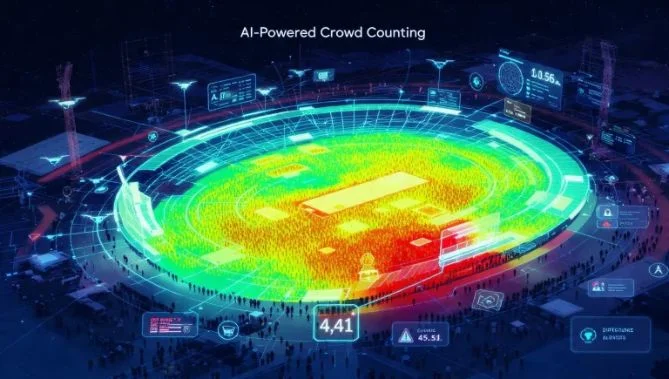
In today’s rapidly urbanizing and interconnected world, managing large gatherings is no longer just about logistics—it is about safety, efficiency, and informed decision-making. Whether at a music concert, airport terminal, shopping mall, or political rally, knowing how many people are present and how they are distributed is essential.
Traditional methods such as manual counting or turnstiles fall short in dense and dynamic environments. This is where AI-powered crowd counting models are transforming the landscape, delivering accurate, scalable, and real-time solutions.
What is Crowd Counting?
Crowd counting refers to estimating the number of people in a scene using visual data from CCTV cameras, drones, or mobile devices. Modern AI models use computer vision and deep learning to analyze patterns, textures, and densities, making them reliable even in highly congested settings.
Instead of relying solely on detecting individuals—an almost impossible task in dense crowds—these models generate density maps or use hybrid techniques to produce scalable, consistent results.
How Do AI Crowd Counting Models Work?
Crowd counting models operate at the intersection of computer vision, deep learning, and statistical modeling.
1. Detection-Based Approaches: Detect individuals using models like YOLO or Faster R-CNN. Best for sparse crowds; struggles in dense overlaps.
2. Density Estimation Models: Generate heatmaps to estimate regional densities. Examples: MCNN, CSRNet. Highly effective in dense environments:
3. Regression-Based Approaches: Directly map features to a count, skipping detection or density maps. Lightweight but less detailed. 04. Hybrid Models: Blend detection and density estimation dynamically. Example: Switch-CNN.
“Think of detection as “counting heads individually,” density estimation as “measuring how crowded each region is,” and hybrid approaches as “choosing the best method based on the situation.” For non-technical readers
Key Technical Innovations
To give AI professionals deeper insights, here are some innovations pushing the field forward:
1. Dilated Convolutions (CSRNet): Capture global context while preserving resolution.
2. Attention Mechanisms: Focus on important regions like faces or shoulders.
3. Domain Adaptation: Transfer learning to generalize across geographies and datasets.
4. Edge AI Deployment: Running models directly on surveillance cameras or drones for real-time use.
Applications Across Sectors
Crowd counting goes beyond academic curiosity. It is already powering real-world use cases across industries:
1. Public Safety & Governance: Governments use real-time monitoring during festivals, protests, or emergencies to avoid overcrowding and deploying resources strategically.
2. Transportation & Smart Cities: Airports and metro systems leverage crowd data to reduce congestion, optimize passenger flow, and plan infrastructure expansions.
3. Retail & Business Analytics: Malls and large retail outlets analyze visitor flow and peak timings to improve staffing, marketing, and customer experience.
4. Event Management: Organizers of sports events and concerts rely on accurate headcounts to ensure compliance with safety regulations and optimize logistics.
5. Disaster Management: During floods, earthquakes, or evacuations, crowd flow monitoring helps first responders plan safer evacuation routes.
Benefits for Organizations
Accuracy at Scale: From hundreds to tens of thousands of people, AI models provide reliable estimates.
Cost Efficiency: Reduces dependence on manual counting and costly infrastructure. Real-Time Insights: Helps in live monitoring and proactive decision-making.
Strategic Advantage: Beyond safety, crowd intelligence offers valuable business insights into behavior and movement patterns.
Challenges to Consider
Despite progress, several challenges remain: Privacy Concerns: Organizations must ensure compliance with data protection laws (e.g., GDPR) and design models that anonymize individuals.
Environmental Factors: Models must handle variations like low lighting, weather conditions, or unusual camera angles.
Bias & Generalization: A model trained on one dataset may underperform in a different cultural or geographic setting unless adapted.
Infrastructure Costs: While models themselves are efficient, large-scale deployment may require upgrades in camera networks and computing hardware.
The Future of Crowd Counting
Looking ahead, we can expect several exciting trends:
Integration with IoT: Linking crowd data with sensors, drones, and other smart devices for holistic situational awareness.
Predictive Analytics: Moving from “counting now” to forecasting future crowd movements and densities.
Privacy-Preserving AI: Leveraging techniques like federated learning to train models without compromising sensitive data. Multimodal Systems: Combining video feeds with Wi-Fi, GPS, or sensor data to improve robustness.
Explainable AI in Counting: Offering interpretable outputs (e.g., heatmaps and bounding boxes) to build trust among non-technical stakeholders.
Our Observations
1. YOLO V8 XL works great for small room size area.
2. CSRNET: Used original pre trained weights of shanghai A and B. Shanghai A is for congested crowd. Shanghai B is for sparse crowds. We tried on both weights, and they perform good. Finetuning is required if it is to be applied in a particular area. We can also try training on different datasets like UCF CC 50, WorldExpo’10, UC SD. Much research shows that CSRNet when trained on UCF-CC_50 reported a MAE of 10.0 and MSE of 15.7. CSRNET when trained on Mall dataset MAE of 0.10 and an MSE of 0.08
3. YOLO-Crowd performed well for counting crowd of 200 people
4. Depending on where the crowd counting must be done, there is a need to either fine tune a pre-trained model or create a new model from scratch
Conclusion
AI-powered crowd counting is no longer just an academic challenge—it is a vital tool for governments, corporations, and communities. By combining deep learning, computer vision, and real-time analytics, these models deliver not only accurate counts but also actionable insights for safety, planning, and strategy.
For businesses, it means smarter operations. For governments, it means safer cities. For AI professionals, it presents a field rich with technical challenges and opportunities for innovation. As technology evolves, crowd counting will transition from being a reactive tool to a predictive engine, shaping how societies plan, govern, and thrive in an increasingly crowded world.