Attention Is All You Need: The Transformer Story in LLMs
In the world of Artificial Intelligence, few innovations have been as groundbreaking as the Transformer architecture. Introduced in 2017 by Vaswani et al. in the landmark paper “Attention Is All You Need”, Transformers have completely redefined how machines understand and generate human language. They are the foundation behind today’s most advanced Large Language Models (LLMs) such as GPT, BERT, Claude, and Gemini.
So, what makes Transformers so powerful, and why did they change the game? Let’s explore.
1. Before Transformers: The Bottlenecks of RNNs and LSTMs
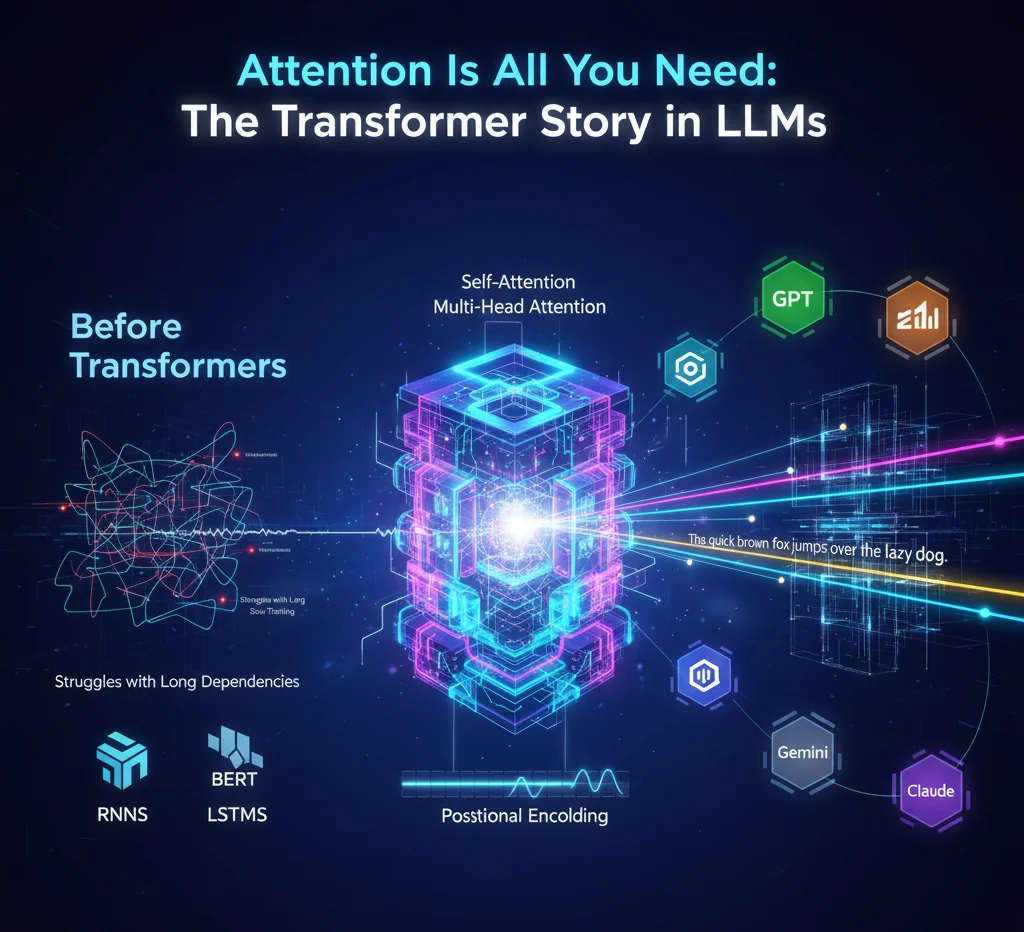
Before 2017, natural language processing (NLP) relied heavily on Recurrent Neural Networks (RNNs) and Long Short-Term Memory (LSTMs). These models processed text sequentially, word by word. While effective for short sentences, they struggled with:
-
- Long-range dependencies: remembering context from earlier words in long passages.
-
- Slow training: since computations had to be done in order, they couldn’t be parallelized easily.
-
- Vanishing gradients: important information got lost as sequences grew longer.
The AI community knew it needed a more efficient way.
2. The Transformer Breakthrough
The Transformer solved these problems by introducing a revolutionary concept: attention mechanisms. Instead of processing words one at a time, Transformers look at all words in a sequence simultaneously and decide which ones are most relevant to each other.
The key innovation is self-attention, which answers:
For a given word, which other words in the sentence should it “pay attention” to?
This made it possible to capture long-range relationships instantly, while enabling parallelization that dramatically sped up training.
3. Why “Attention Is All You Need”
The title of the paper wasn’t just catchy—it was accurate. The authors demonstrated that attention alone, without recurrence or convolution, was enough to achieve state-of-the-art performance in machine translation.
This architecture introduced:
-
- Encoder-decoder layers for processing and generating sequences.
-
- Multi-head attention to capture different types of relationships simultaneously.
-
- Positional encoding to preserve the order of words, since Transformers don’t inherently process sequentially.
4. The Rise of Large Language Models
Once Transformers proved their worth, the AI world quickly scaled them up:
-
- BERT (2018) → Focused on bidirectional understanding of language, powering search engines and NLP tasks.
-
- GPT series (2018–present) → Demonstrated generative capabilities, from text completion to reasoning.
-
- T5, PaLM, LLaMA, Gemini, Claude → Continued expansion into multimodal AI, reasoning, and agentic AI.
Today’s LLMs with billions (or even trillions) of parameters are possible only because of the efficiency and scalability of the Transformer architecture.
5. Why It Matters Beyond AI Labs
Transformers aren’t just for AI researchers. Their impact is everywhere:
-
- Search engines provide more relevant answers.
-
- Chatbots like ChatGPT assist with education, work, and creativity.
-
- Healthcare AI helps analyze medical records and predict outcomes.
-
- Translation tools break down global communication barriers.
In short, Transformers made natural language understanding and generation practical at scale.
6. The Future of Transformers in LLMs
The story isn’t over. Researchers are now exploring:
-
- Efficiency improvements (like sparse attention) to handle massive datasets more sustainably.
-
- Multimodal Transformers that combine text, images, audio, and video.
-
- Agentic AI powered by LLMs that don’t just generate text but take actions.
The Transformer will continue to evolve, but its core principle—attention—remains the heartbeat of modern AI.
Final Thoughts
The phrase “Attention Is All You Need” has proven prophetic. By reimagining how machines focus on information, the Transformer unlocked the era of Large Language Models—tools that are reshaping industries, workflows, and human-AI collaboration.
The Transformer story is a reminder that one brilliant architectural shift can ignite an entire revolution.